Get in touch
Discover ARTEX, an open-source autonomous penetration testing platform combining AI agents, real security tools, and evidence-driven vulnerability assessment.
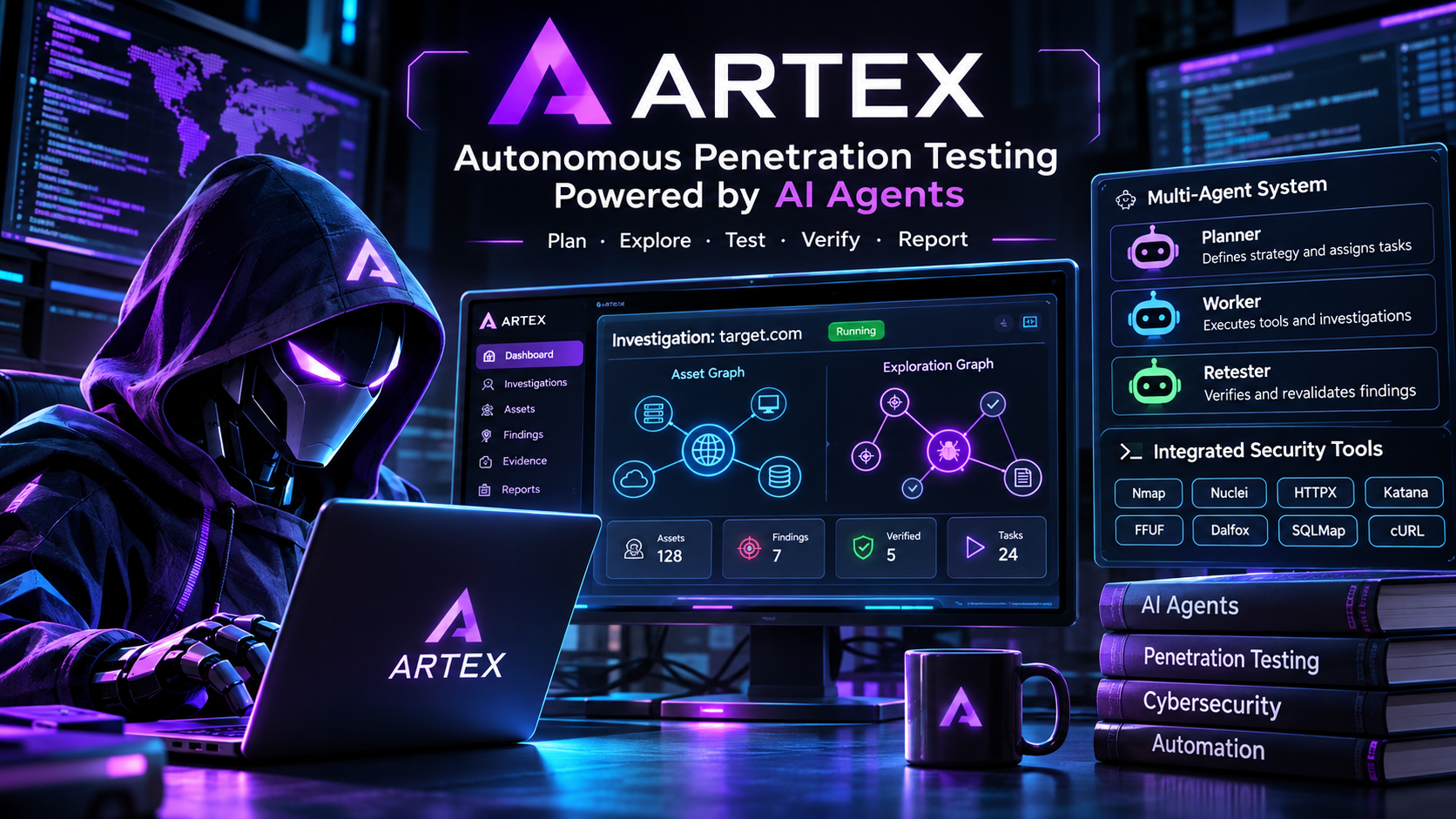
Discover ARTEX, an open-source autonomous penetration testing platform combining AI agents, real security tools, and evidence-driven vulnerability assessment.
Tags: ARTEX, AI Cybersecurity, Autonomous Penetration Testing, Ethical Hacking, AI Agents, Open Source Security, Red Team, Security Automation.
---
Introduction
Artificial Intelligence is rapidly transforming the cybersecurity landscape. Traditional penetration testing often requires significant manual effort, specialized tools, and extensive analysis of security findings.
But what if AI agents could plan security assessments, execute real security tools, investigate discovered assets, and continuously validate potential vulnerabilities?
This is exactly the direction explored by ARTEX, an open-source, self-hosted autonomous penetration testing platform.
ARTEX is not simply another AI chatbot connected to a vulnerability scanner. It introduces a multi-agent architecture in which AI-powered planners and workers collaborate to perform structured security assessments, maintain investigation history, and associate findings with actual evidence.
GitHub Repository: https://github.com/BaaRai/ARTEX
1. What Is ARTEX?
ARTEX is an LLM-driven autonomous penetration testing platform designed to coordinate complex security testing workflows.
Instead of executing a predefined sequence of commands, ARTEX uses an intelligent planning and execution loop.
Its architecture revolves around several key responsibilities:
- Planning security objectives.
- Breaking objectives into smaller testing tasks.
- Assigning tasks to autonomous workers.
- Executing real security tools.
- Collecting and organizing discovered assets.
- Recording HTTP traffic and supporting evidence.
- Validating findings through dedicated retesting workflows.
The system continuously evaluates the progress of an investigation and determines whether additional testing directions are necessary.
This approach makes ARTEX particularly interesting for security researchers, penetration testers, and developers experimenting with autonomous AI systems.
2. Multi-Agent Architecture: Planning, Execution and Collaboration
One of ARTEX's most interesting features is its multi-agent architecture.
Rather than relying on a single AI model to handle every operation, the platform separates planning from execution.
The Planner
The Planner acts as the coordinator of the testing process.
It analyzes the overall objective, examines the current exploration state, identifies uncovered testing directions, and dispatches new intents to available workers.
The Workers
Workers execute the assigned tasks using real tools and capabilities.
Depending on the testing objective, they can interact with Bash commands, HTTP services, and specialized security utilities.
Each worker operates within its assigned intent and writes observations, facts, assets, and findings back into the platform.
Shared Worker Intelligence
ARTEX also allows workers to search execution traces generated by other workers.
This means that useful observations can be reused even when they have not yet been converted into formal findings.
For multi-step investigations, the Planner maintains a task-level to-do list across multiple execution rounds.
The result is a coordinated system capable of maintaining context throughout an investigation.
3. Dual-Graph Architecture: Understanding Assets and Exploration
ARTEX introduces an interesting architectural concept: two interconnected graphs that represent different aspects of a security assessment.
Asset Graph
The Asset Graph represents the infrastructure being tested.
It organizes information such as:
- Root domains.
- Subdomains.
- IP addresses.
- Services.
- Applications.
- Endpoints.
Assets are shared across tasks within the relevant company scope, allowing information to be reused instead of rediscovered.
Exploration Graph
The Exploration Graph represents the progress and reasoning associated with an individual task.
It stores:
- Goals.
- Intents.
- Facts.
- Findings.
- Hints.
- Relationships between investigation steps.
Anchors connect exploration nodes to actual infrastructure assets.
This creates a traceable relationship between what was discovered, what was tested, and which asset was involved.
For security professionals, this is particularly valuable because it provides more context than a traditional scanner output.
4. Evidence-Based Vulnerability Verification
One of the biggest challenges with AI-powered security tools is distinguishing between a plausible vulnerability and a demonstrably verified issue.
ARTEX addresses this problem through traffic recording and evidence management.
Its recording MITM proxy captures HTTP traffic generated during testing.
A browser extension provides additional capabilities for authenticated environments, allowing users to browse applications while recording relevant requests and responses.
The captured evidence can be associated with individual findings.
Key capabilities include:
- Request and response recording.
- Evidence quotes linked to findings.
- Verification status and proof-of-evidence levels.
- Traffic replay.
- Vulnerability retesting.
- Report generation and export.
ARTEX also includes a dedicated Retester agent.
This agent can investigate whether a previously identified vulnerability remains reproducible, has been fixed, or cannot currently be confirmed.
This is an important distinction: security findings should be supported by evidence, not merely generated by an AI model.
5. Real Security Tools Integrated into the Workflow
ARTEX combines AI-driven orchestration with established security utilities.
Its included scanner toolchain features tools such as:
Tool| Typical purpose
Nmap| Network and service discovery
Nuclei| Template-based vulnerability detection
HTTPX| HTTP probing
Katana| Web crawling
FFUF| Web content discovery
Dalfox| XSS testing
SQLMap| SQL injection testing
cURL| HTTP interactions
These tools provide practical capabilities to the workers.
The AI layer coordinates their execution based on the investigation context rather than simply running every available tool indiscriminately.
6. Multiple LLM Providers and Local AI Models
Another important advantage of ARTEX is its model flexibility.
The platform supports multiple LLM providers, including:
- OpenAI.
- Anthropic.
- OpenAI-compatible API endpoints.
- Ollama for local model deployments.
Users can configure multiple LLM profiles and enable worker rotation.
This allows successive worker intents to be assigned to different configured providers.
For organizations experimenting with AI-powered security automation, model flexibility is an important architectural advantage.
It also allows different deployment strategies depending on infrastructure, budget, and operational requirements.
7. Security Controls and Human Oversight
Autonomous security testing must include strong operational safeguards.
ARTEX incorporates several mechanisms designed to control how agents interact with target systems.
Scope enforcement: Testing is restricted to assets included in the declared scope.
Human-in-the-loop approvals: Tool executions can require human approval based on configurable rules.
Execution budgets: Token and turn budgets limit resource consumption.
Target noise governor: Request pacing, concurrency limits, jitter, and backoff help control testing traffic.
Prompt injection protection: Tool outputs are framed as untrusted data rather than instructions for the agents.
These controls are important because autonomous execution should never mean unrestricted execution.
Human oversight remains essential, particularly in production environments.
8. Technology Stack and Architecture
ARTEX combines several modern technologies into a self-hosted platform.
Component| Technology
Backend| Go
Frontend| Next.js
Database| PostgreSQL
Deployment| Docker
AI providers| OpenAI, Anthropic, Ollama
Agent capabilities| norma SDK
Traffic recording| MITM proxy
Integration| MCP
The frontend is embedded into the Go binary using "go:embed", resulting in a deployment model that requires PostgreSQL as its main external dependency.
This architecture simplifies installation and administration.
9. Installing ARTEX
Getting started is relatively straightforward if Docker is already installed.
Clone the repository:
git clone https://github.com/BaaRai/ARTEX.git
cd ARTEX
Create the environment configuration:
cp .env.example .env
Configure your PostgreSQL password and, optionally, your preferred LLM API key.
Build and start the platform:
docker compose up -d --build
Once the services are running, open:
“http://localhost:8787”
During the first visit, ARTEX requires a one-time setup token printed in the startup logs.
For the complete installation process, configuration options, and alternative deployment methods, consult the official GitHub repository.
10. Why ARTEX Matters for the Future of Cybersecurity
The evolution of AI agents introduces new possibilities for security automation.
Traditional security scanners are generally designed to execute predefined checks and report their results.
ARTEX explores a different model: an AI-driven system that can plan testing activities, execute tools, retain investigation context, and continuously evaluate whether its objectives have been achieved.
This does not eliminate the need for experienced penetration testers.
Instead, it introduces a framework in which specialists can potentially delegate repetitive investigative activities to autonomous agents while retaining control over scope, approvals, and final conclusions.
The combination of AI reasoning, real security tools, shared execution context, and evidence-based findings makes ARTEX an interesting project to follow.
Conclusion
ARTEX represents an exciting direction in the convergence of artificial intelligence and offensive security.
Its multi-agent architecture, interconnected asset and exploration graphs, traffic recording, vulnerability verification, and support for multiple LLM providers make it more than a conventional automated scanner.
It is an experimental step toward a new generation of autonomous security assessment platforms.
For cybersecurity professionals, ethical hackers, developers, and AI researchers, ARTEX is definitely worth exploring.
Explore the project on GitHub:
https://github.com/BaaRai/ARTEX
License: GNU Affero General Public License v3.0 (AGPL-3.0).
---
Disclaimer: ARTEX is an offensive security tool. It must only be used against systems you own or systems for which you have explicit authorization. Always respect applicable laws, testing scopes, and responsible disclosure requirements.
Your email address will not be published. Required fields are marked *
Cookie preferences