Get in touch
AI – Built for Decisions, Not Conversations
Artificial intelligence is evolving rapidly. Most people are familiar with tools such as ChatGPT, Claude, and Gemini, which can generate text, answer questions, write code, and assist with everyday tasks.
But what if AI didn't need to generate words to be useful?
What if, instead of writing long answers, an AI model could analyze information, make decisions, evaluate possibilities, and return structured results that software could immediately understand and use?
This is the idea behind Jev, an artificial intelligence model developed by TypeSafe AI.
Jev introduces a different approach to AI: rather than focusing on conversations and content generation, it is designed to make fast, structured, and probability-based decisions.
Let's explore what Jev is, how it works, and why it could become an interesting technology for the future of AI-powered automation.
Jev is an AI model developed by TypeSafe AI and introduced on September 15, 2026.
It is the company's first public System One Model, a new category of AI models designed specifically for machine-driven decisions.
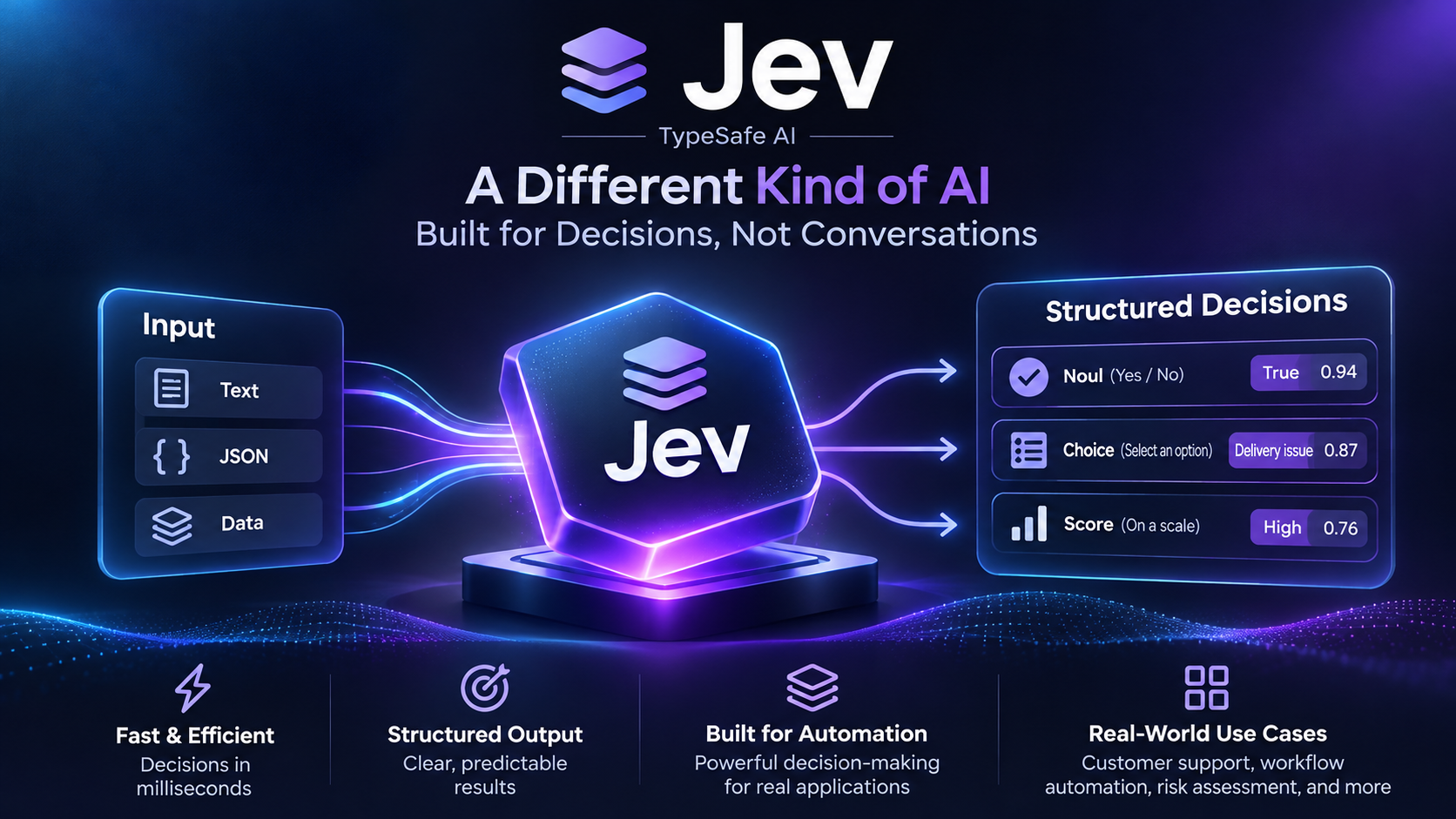
Unlike traditional large language models (LLMs), Jev does not generate natural-language responses. Instead, it receives information and answers predefined questions using structured values, probabilities, and confidence estimates.
In simple terms:
This distinction is important because many software applications don't need an AI model to write an explanation. They need it to classify information, evaluate a situation, select an option, or determine what action should happen next.
Jev is designed for precisely these situations.
Jev works with two main components:
1. State
The state represents the information the model needs to analyze. It can be plain text, a JSON object, or an array of text entries.
For example, imagine receiving a customer support message:
"My package hasn't arrived, and the delivery date was three days ago."
This message becomes the input state.
2. Questions
You then provide predefined questions about that information.
For example:
Jev analyzes the information and returns structured answers with probability distributions.
Instead of generating a paragraph explaining its reasoning, it provides results that your software can process directly.
Jev supports three main question types:
1. Noul – Yes or No Questions
These questions evaluate whether a statement is true or false based on the supplied information.
Example:
Is the customer reporting a delivery problem?
Possible answers:
2. Choice – Selecting an Option
This question type allows Jev to select the most appropriate option from a predefined list.
Example:
What is the main category of this customer request?
Possible answers:
3. Score – Evaluating on a Scale
Score questions allow you to evaluate information using an ordered set of possible values.
Example:
How urgent is this customer request?
Possible answers:
Each question produces a probability distribution, allowing the surrounding application to interpret the result and decide what to do next.
An interesting feature is that multiple questions can be answered in parallel within a single request.
Both technologies use artificial intelligence, but they are designed for different purposes.
ChatGPT and other large language models are optimized for generating flexible language-based responses. Jev is optimized for producing structured decisions.
Here are some of the main differences:
| Feature | Traditional LLMs | Jev |
|---|---|---|
| Primary purpose | Text generation and reasoning | Structured decisions |
| Output | Natural language | Typed values and probabilities |
| Processing | Sequential token generation | Parallel question answering |
| Main applications | Chatbots, writing, coding | Classification, scoring, automation |
| Output structure | Can require parsing and validation | Predefined output types |
| Confidence | Can be inconsistent | Designed to provide calibrated probabilities |
The most important difference is that Jev doesn't try to replace conversational AI.
Instead, it addresses a different problem: making AI decisions easier for software to consume.
TypeSafe AI describes Jev as the first model in a category called System One Models.
The name is inspired by psychologist Daniel Kahneman's distinction between two modes of human thinking, popularized in his book Thinking, Fast and Slow.
The idea behind System One Models is to create AI systems that can make fast decisions based on information provided to them.
Rather than generating long explanations, these models focus on returning structured answers that applications can immediately use.
This approach is particularly interesting for automation, where speed, predictable output formats, and the ability to handle uncertainty are important.
Jev has potential applications across many industries and software systems.
Here are some practical examples:
1. Customer Support Automation
Jev can classify incoming support messages, identify customer issues, evaluate urgency, and help route requests to the appropriate department.
2. Business Process Automation
Companies can use Jev to evaluate incoming information and determine which step of a workflow should happen next.
3. Fraud Detection and Risk Assessment
Jev can evaluate predefined risk indicators and help classify transactions or activities according to specific criteria.
Such applications would still require appropriate validation and additional security controls.
4. Content Moderation
It can evaluate submitted content against predefined categories and help identify material that requires further review.
5. AI Agent Systems
Jev can act as a decision-making component inside larger AI applications.
For example, a traditional language model could generate a response, while Jev evaluates the response, checks predefined conditions, or determines which tool should be used next.
6. Real-Time Applications
Because Jev is designed for fast inference, it could be useful in applications where decisions need to happen quickly.
One of the most interesting aspects of Jev is its focus on efficiency.
According to TypeSafe AI, Jev achieves response times between approximately 70 and 500 milliseconds in the company's published workflow evaluations.
The company also reports substantial speed and cost advantages compared with selected frontier language models on comparable tasks.
However, these figures should be interpreted carefully. They come from TypeSafe's own evaluations, and actual performance depends on the workload, infrastructure, and complexity of the task.
Jev's design is particularly interesting for applications that need to process large volumes of information and make repeated decisions.
Instead of generating unnecessary text, the model returns the information the application actually needs.
No. These technologies serve different purposes.
ChatGPT is designed to understand and generate language, explain complex topics, assist with writing, generate code, and support conversations.
Jev is designed to evaluate information and return structured decisions.
Think about a customer service platform.
You might use ChatGPT to write a personalized response to a customer, while Jev determines whether the request concerns billing, delivery, or a technical problem.
Together, different AI models can become components of a much larger intelligent system.
The future of AI may not be about finding one model that does everything, but about combining specialized models that perform specific tasks effectively.
No AI system should be considered perfect.
Although Jev is designed to provide structured outputs and calibrated confidence estimates, this does not mean every decision is necessarily correct.
A valid output format does not guarantee factual accuracy.
The quality of its decisions still depends on the information provided, the questions being asked, the model's capabilities, and the way the surrounding application handles uncertainty.
For critical applications, human oversight, testing, and appropriate validation remain essential.
It is also worth noting that Jev is a proprietary model, and TypeSafe AI has not publicly disclosed all the technical details of its architecture and training process.
Jev represents an interesting direction in artificial intelligence.
While much of the AI industry focuses on models that can generate increasingly sophisticated conversations, TypeSafe AI is exploring a different approach: models designed to make decisions that software can use directly.
This distinction could become increasingly important as AI moves beyond chat interfaces and becomes deeply integrated into business processes, applications, and automated systems.
Jev is not designed to replace ChatGPT or other conversational AI tools. Instead, it introduces another building block for creating more efficient AI-powered applications.
Perhaps the next big step in artificial intelligence isn't just teaching machines to communicate better with humans, but teaching them to make useful decisions for the software systems we rely on every day.
And that is what makes Jev worth watching.
Your email address will not be published. Required fields are marked *
Cookie preferences